
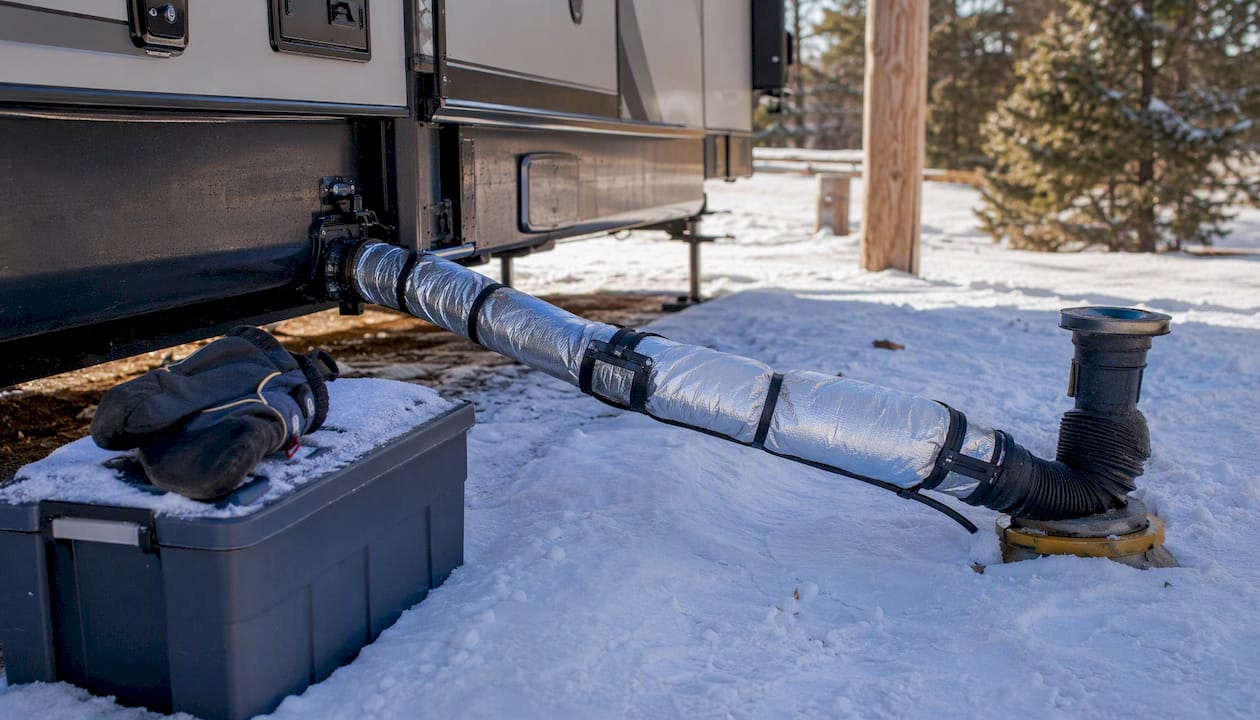
If temperatures at your campsite regularly drop below 41°F overnight, you need an active heated sleeve, not just a passive cover. For milder conditions, a well-fitted insulated or UV-resistant sleeve paired with an elevated support is usually enough to prevent freezing and protect your hose. The two fastest decision signals: if you’re camping through sustained subfreezing nights or at elevation without reliable shore power, go heated. If your winters are brief and mild, good insulation plus a solid support system does the job.
Table of Contents
- How do you choose between insulation and active heating?
- What types of protective sewer-hose solutions actually exist?
- What features should you check before buying?
- How do you install and maintain a sewer hose cover on uneven terrain?
- Why Rvlevitator’s support and sleeve system works on uneven terrain
- What do covers, sleeves, and support systems typically cost?
- Key Takeaways
- The case for getting the support right, not just the sleeve
- Rvlevitator’s combined support and sleeve kit is ready to order
- Sources and further reading
How do you choose between insulation and active heating?
The choice comes down to four variables: your typical overnight low, how long freezes last, whether you have shore power or a generator, and how often you camp in winter.
Run through this checklist before you buy:
- Typical low temp above 32°F? A snug insulated sleeve plus an elevated support is likely sufficient for most nights.
- Temps regularly hitting 20°F or below? Active heating is the safer call, especially for multi-night stays.
- No reliable shore power? A heated sleeve won’t help without electricity. Factor in a generator or battery inverter.
- High elevation or exposed sites? Wind chill accelerates freezing. Lean toward active heating even at moderate temps.
- Occasional winter trips only? Passive insulation handles short, mild freezes without the wiring hassle.
Heated sleeve thermostats typically activate when temperatures drop below about 41°F (5°C) and shut off above about 59°F (15°C), so the heating element only runs when it’s actually needed.
Freeze protection claim: Some heated sleeve product pages advertise protection down to -45°F (-43°C), which covers the vast majority of North American winter camping conditions. For sustained temperatures below -10°F, active heating is not optional.
For mild-winter regions, insulation alone often prevents freezes when paired with a good elevated support that keeps water moving downhill and avoids sag pockets where ice forms first.
What types of protective sewer-hose solutions actually exist?
Not every product labeled “heat resistant” does the same thing. Here’s what’s actually on the market and what each one is for.
| Solution type | Freeze protection | Power needed | Best climate |
|---|---|---|---|
| Heated sleeve | Yes, active | Yes (GFCI) | Sustained subfreezing |
| Insulated/foil-backed sleeve | Partial, passive | No | Mild winter, short freezes |
| UV/vinyl protective cover | No | No | Year-round sun/abrasion |
| Elevated tension-line support | Indirect (prevents sag ice) | No | All terrain types |
| Industrial firesleeve | No (wrong tool) | No | High external heat only |

**Heated sleeves wrap around your existing hose and contain a self-regulating heating cable. They’re the right choice for serious cold.
Insulated sleeves use foil-backed or foam lining to slow heat loss. They work well for temperatures that dip just below freezing for a few hours.
UV-resistant vinyl covers protect from sun degradation, dirt, and abrasion. They don’t insulate meaningfully but extend hose life significantly in sunny climates.
Elevated supports keep the hose off the ground and angled for drainage. On uneven terrain, this prevents the sag pockets where water pools and freezes first.
Pro Tip: If you want one sleeve that works for both your RV sewer hose and outdoor drains at home, choose a removable heated sleeve. You can pull it off the hose at the end of the season and use it on a yard drain or house standpipe.
Don’t confuse industrial firesleeves with freeze protection. Products like the Ryco FS1072 and similar glass fiber and silicone sleeves are engineered to protect hoses from external radiant heat up to 260°C (500°F). They contain no heating elements and provide zero active warmth. Using one on an RV sewer hose in freezing weather will not prevent ice formation.
What features should you check before buying?
A quick checklist to run through before you add anything to your cart:
Sizing and compatibility
- Fits standard 3-inch RV sewer hose diameter
- Available in 15 ft or 20 ft lengths to cover your full run
- Velcro or zip closure for a snug, gap-free fit
Electrical and safety specs
- Thermostat activates below about 41°F (5°C), shuts off above about 59°F (15°C)
- Internal overheat cutoff around 194°F (90°C) to prevent damage
- Outdoor-rated power cord and plug
- Always use with a GFCI outlet or GFCI extension cord
Materials and weatherproofing
- Waterproof outer fabric (600D Oxford or equivalent)
- Foil-backed insulation layer for passive heat retention
- UV-resistant coating to prevent cracking in sunlight
Support compatibility
- Sleeve should slide on and off without cutting or permanent attachment
- Confirm the sleeve works alongside tension-line or elevated supports
- Removable design lets you store it dry between trips
Checking these specs before buying saves you a return trip. A sleeve that fits loosely or lacks a proper thermostat range is a liability on a cold night.
How do you install and maintain a sewer hose cover on uneven terrain?
Installation is straightforward, but uneven ground adds a few steps worth doing right.
Step 1: Lay out and sleeve the hose. Stretch your sewer hose to its full length before sliding the sleeve on. Starting from the campsite-end and working toward the RV makes it easier to keep the hose straight.
Step 2: Secure the closures. Fasten every Velcro tab or zipper from end to end. Gaps let cold air in and are where ice forms first. Pay extra attention at connection points where the hose meets the sewer inlet.
Step 3: Elevate and tension. On uneven terrain, use a tension-line support to lift the hose off the ground and create a continuous downhill slope toward the dump station. Sag pockets trap water, and trapped water freezes. Rvlevitator’s setup instructions walk through the tensioning process for different site layouts.

Step 4: Connect power safely. Plug the heated sleeve into a GFCI-protected outlet. Route the power cord so it doesn’t sit in standing water or puddles. Confirm the thermostat light or indicator activates when temps drop.
Pro Tip: Before your first winter trip of the season, plug in the heated sleeve at home and put it in a cold garage or freezer bag overnight. If the thermostat activates and the sleeve warms up, it’s working. Don’t wait until you’re at a campsite at midnight to find out it’s dead.
Maintenance matters year-round. Clean and fully dry the sleeve before storing it. A damp sleeve stored in a bin grows mildew fast, and the odor transfers to your hose. Check the power cord for abrasion or cracking each season.
Troubleshooting:
- Hose still stiff above freezing? Check that the thermostat is actually activating. Test with a thermometer near the sleeve.
- Hot spots on the sleeve exterior? Unplug immediately and inspect for damaged wiring or a kinked heating cable.
- Sleeve not staying closed? Replace worn Velcro strips before the next trip, not during.
For off-season hose storage tips, keeping both the hose and sleeve clean and dry extends the life of both.
Why Rvlevitator’s support and sleeve system works on uneven terrain
Most RV sewer problems on uneven sites come down to one thing: sag. A hose that dips in the middle holds water, and held water freezes, smells, and backs up. Rvlevitator’s tension-line support system lifts the hose above the ground and keeps it angled for gravity drainage regardless of what the terrain underneath looks like.
The UV-resistant vinyl sleeve included with Rvlevitator’s system protects the hose from sun cracking, dirt, and abrasion year-round. For winter campers, it layers directly with a heated sleeve, so you get both active warmth and physical protection in one setup.
Key practical benefits:
- Universal hose fit works with standard 3-inch accordion-style sewer hoses
- Quick install with no tools required, typically done in under 30 minutes on most sites
- Modular design lets you add or remove the sleeve independently of the support
- Money-back guarantee with compensation for customer feedback, so there’s no risk in trying it
The support system is especially useful at sites with rocky, sloped, or soft ground where traditional plastic ramps tip over or sink.
What do covers, sleeves, and support systems typically cost?
| Solution | Typical cost range | Setup time |
|---|---|---|
| Passive insulated sleeve | $20–$45 | 10–15 minutes |
| Heated sleeve (15–20 ft) | — | 15–30 minutes |
| Combined support + sleeve kit | — | 20–45 minutes |
Longer runs, integrated heated hoses (where the heating cable is built into the hose itself rather than a removable sleeve), and heavy-duty weatherproof materials push costs toward the higher end. A removable heated sleeve is almost always cheaper than a dedicated heated hose and easier to replace if it fails.
Setup time on uneven terrain adds 10–15 minutes over a flat site because you’re adjusting the tension line to get the right drainage angle. Budget for that on your first install.
Key Takeaways
A heated sleeve is the right choice for sustained subfreezing camping; passive insulation plus an elevated support handles mild winter conditions reliably.
| Point | Details |
|---|---|
| Active heating threshold | Use a heated sleeve when overnight temps regularly fall below 41°F. |
| Passive insulation limit | Insulated sleeves work for short, mild freezes but not sustained subfreezing nights. |
| Terrain and sag | Elevated tension-line supports prevent sag pockets where water pools and freezes first. |
| Safety before deployment | Test thermostat activation and confirm GFCI-protected power before relying on a heated sleeve in the field. |
| Rvlevitator solution | Rvlevitator’s tension-line support plus UV-resistant sleeve pairs with any heated sleeve for full winter protection on uneven terrain. |
The case for getting the support right, not just the sleeve
Most RVers shopping for a heat resistant sewer hose cover focus entirely on the sleeve and forget the support. That’s understandable, but it’s the wrong order of operations. A heated sleeve on a sagging hose still has ice-risk points at every low spot. The sleeve warms the hose, but gravity still wins if the hose isn’t elevated and angled correctly.
The tension-line approach Rvlevitator uses solves this at the root. By keeping the hose suspended above the ground, you eliminate the sag pockets before they become freeze points. The sleeve then does its job on a hose that’s already set up for drainage. That combination, support first, sleeve second, is what actually works in practice on the kinds of uneven sites most RVers encounter.
Passive insulation gets underestimated too. For RVers in the South or at lower elevations, a well-fitted UV-resistant sleeve and a solid support system handles the majority of winter nights without any wiring at all. Save the heated sleeve for the trips where you know you’re heading into real cold.
Rvlevitator’s combined support and sleeve kit is ready to order
If you want a setup that handles uneven terrain, protects your hose from UV and abrasion, and pairs cleanly with a heated sleeve for winter trips, Rvlevitator’s RV sewer hose support system is built for exactly that.

No tools, no guesswork, and no permanent modifications to your hose. The kit installs in under 30 minutes, fits standard 3-inch accordion sewer hoses, and comes with a money-back guarantee plus compensation for your feedback.
Setup instructions are available at rvlevitator.com/instructions. Browse the full range of sewer hose covers to find the right fit for your rig and your campsite.
Sources and further reading
- TheCampingNerd — Best Heated RV Sewer Hose Review for Winter RV Camping — practitioner guidance on when passive insulation suffices vs. when active heating is needed
- Ryco FS1072 Fire Sleeve (product documentation) — industrial firesleeve temperature bands and design specs; useful for understanding why these products are not freeze-prevention devices
- National Fire Sleeve product page — continuous operating temperature ratings and intended use cases for industrial sleeves
- Rvlevitator Sewer Covers product page — UV-resistant vinyl sleeve specs and tension-line support compatibility details
Leave a Reply