
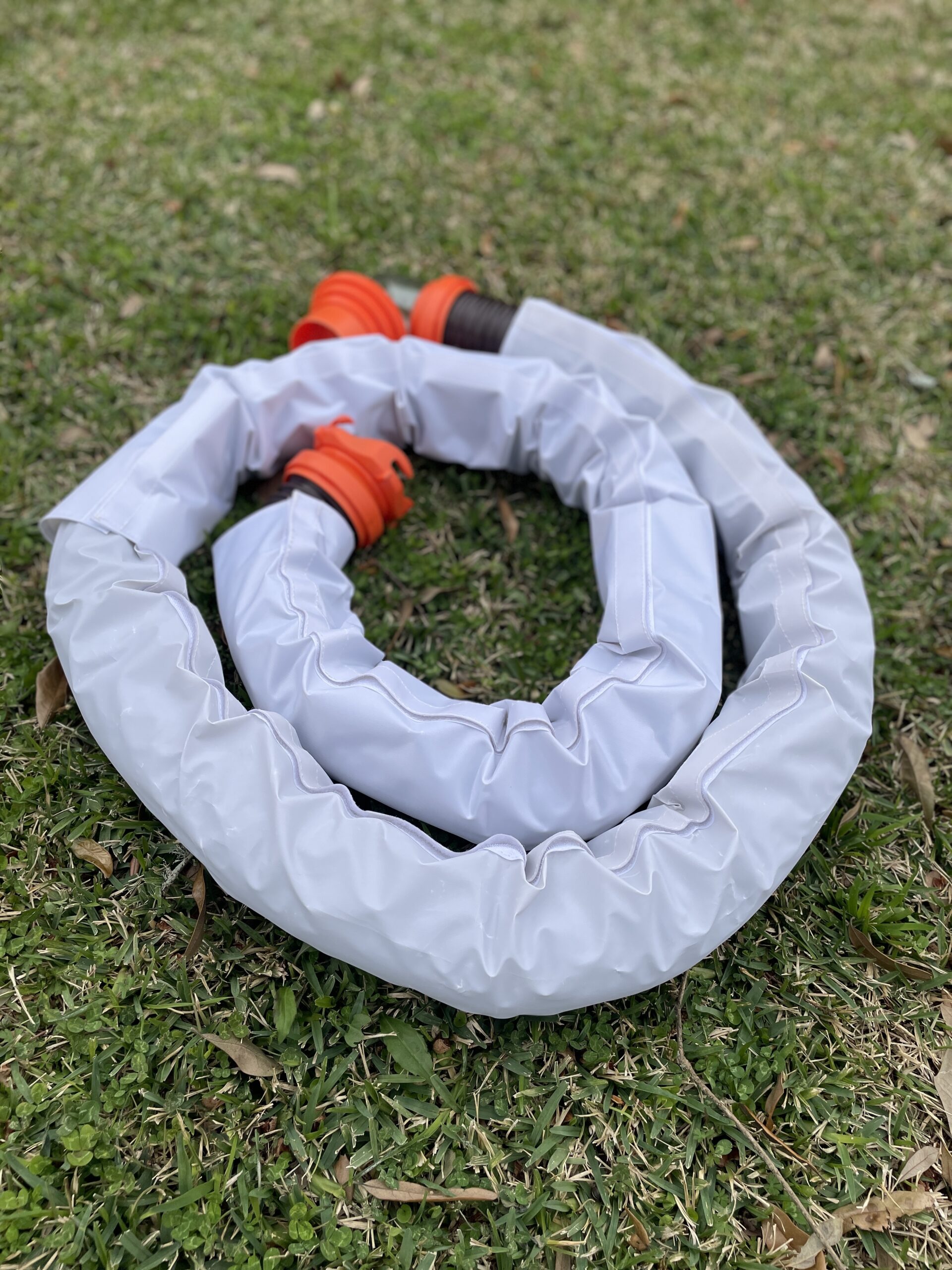
Ask ten RVers whether you really need a sewer hose support and you’ll get a shrug, a lecture, and at least one horror story. Here’s the straight answer: most of the time yes, occasionally no, and the difference comes down to how drainage physics meets your campsite. This guide covers what a support actually does, what happens when you skip one, and how to pick between the two very different types.
What a sewer hose support actually does
A sewer hose only empties completely when every foot of it sits lower than the foot before it. That continuous downhill fall is the entire job of a sewer hose support: hold the hose in a steady slope from your RV’s outlet down to the campground’s sewer connection.
Without that fall, gravity stops helping. Waste water pools in every low spot, sits there between dumps, and slowly becomes the smell you can’t locate. With a proper slope, the hose finishes empty after every dump and there’s nothing left to stink, freeze, or slosh.
What happens if you don’t use one
Plenty of RVers lay the hose straight on the ground. Here’s what that costs over a season:
- Standing waste. Ground is never actually flat. Every dip in the dirt becomes a pocket of waste water that never drains. That’s the number one source of campsite sewer odor.
- Hose damage. UV exposure and ground abrasion are what crack hoses, not use. A hose lying in the sun on gravel is aging on fast-forward.
- Campground rules. Many parks require sewer hoses off the ground, and hosts increasingly check. Showing up without a support can mean an awkward first conversation.
- The backflow surprise. A hose with low spots holds waste right up to the moment you disconnect it. Anyone who has unhooked a “full” hose knows exactly what happens next.
“Sewer hose support” vs “septic hose support”: same thing?
Yes. Some RVers say septic hose, some say sewer hose, some say stinky slinky. Whatever you call the hose, the support’s job doesn’t change: keep it off the ground and keep it sloped. If you searched for a septic hose support, everything on this page applies to you.
When you can genuinely skip a support
Honesty time: a support is not a legal requirement of RV ownership.
- If you only ever dump at dump stations and never camp with full hookups, the hose is connected for two minutes at a time. Skip the support.
- If your hookup site happens to slope perfectly from outlet to sewer inlet, gravity is doing the job free of charge. Enjoy it. Those sites exist, and they’re rarer than campground brochures suggest.
For everyone who parks on real campsites for days at a time, a support pays for itself in not dealing with any of the problems above.
The two types of support, and why the difference matters
Every support on the market is one of two designs:
Ground-following supports (the plastic accordions: Camco Sidewinder, Valterra Slunky, and their cousins) rest on the ground and prop the hose up in a cradle. They’re cheap, they’re everywhere, and on a flat paved pad they work fine. Their weakness is built in: they mirror whatever the ground does. Ruts, soft soil, and slopes pass straight through to your hose.
Suspended supports (the Levitator) hang the hose from a tension line anchored at your outlet and the sewer connection. The ground underneath becomes irrelevant: you set the fall once with the line, and gravel, ruts, and slope can’t undo it.
We compared the leading options head to head, with current prices and an honest look at where each wins: see the Levitator vs. Camco Sidewinder vs. Valterra Slunky comparison.
The terrain test
Before buying, picture the last five campsites you stayed on. Paved and level? An accordion will serve you fine. Gravel, grass, sloped, or rutted? Ground supports inherit every one of those problems. Our uneven-ground guide walks through exactly what each terrain type does to your drainage, site by site.
Bottom line
You need a sewer hose support if you camp with hookups on anything other than perfectly sloped pavement. Which type you need depends on your campsites: accordion for flat and cheap, suspension for everything else. Either way, your hose lasts longer, your site smells like a campsite instead of a sewer, and disconnecting stops being a gamble.
Tired of fighting your sewer hose setup? The Levitator suspends your hose above any terrain: no sags, no pooling, no smell. See how it works or shop the lineup.