
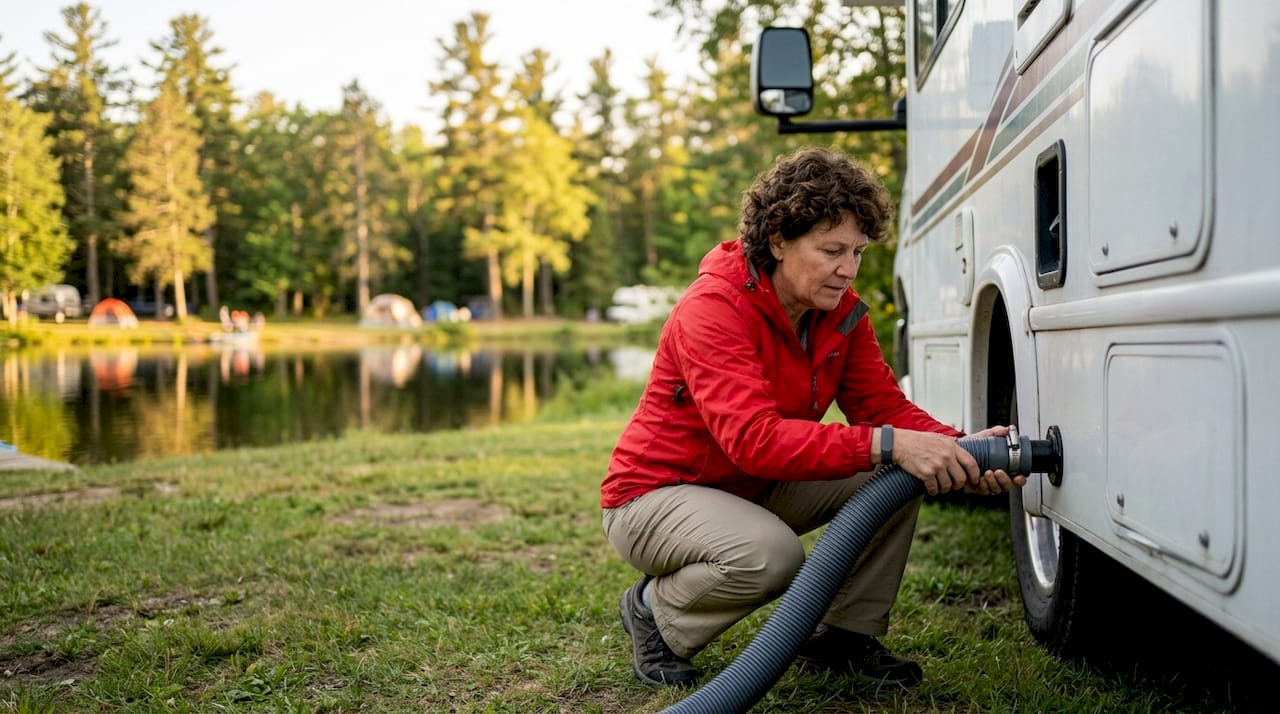
RV dry camping waste management is the practice of handling black and gray water waste responsibly when camping without sewer, water, or electrical hookups. Known in the RV community as boondocking, this style of camping puts full responsibility for sanitation on you. Illegal dumping carries fines from $500 to $25,000 depending on jurisdiction and severity. Getting this right protects the environment, keeps your rig odor free, and keeps you out of legal trouble. This guide covers tank basics, daily habits, dump planning, and the gear that makes it all easier.
How do RV waste tanks work during dry camping?
Your RV runs on two separate waste tanks: the black tank and the gray tank. The black tank collects toilet waste. The gray tank collects water from sinks, showers, and the kitchen. Understanding both is the foundation of any solid boondocking RV waste disposal guide.
Typical fresh water tanks hold 40–60 gallons, and your wastewater tanks are sized proportionally. A solo camper can often stretch a fresh tank to seven days. A family of four may burn through the same supply in two to three days. That difference directly affects how fast your waste tanks fill.

The gray tank fills faster than most RVers expect. Showers, dishwashing, and sink use push gray tank levels up quickly, often faster than the black tank. Many RVers are surprised to find their gray tank full while the black tank still has room. Planning around both tanks separately is the smarter approach.
The table below shows typical fill rates based on group size and water habits.
| Group size | Water habits | Gray tank fills in | Black tank fills in |
|---|---|---|---|
| Solo camper | Conservative | 5–7 days | 7–10 days |
| Solo camper | Average | 3–5 days | 5–7 days |
| Couple | Conservative | 3–5 days | 5–7 days |
| Couple | Average | 2–3 days | 4–5 days |
| Family of four | Average | 1–2 days | 3–4 days |
These ranges are estimates. Your actual fill rate depends on your specific tank sizes, fixtures, and daily habits.
What are the best strategies for managing RV waste while dry camping?
Effective dry camping sanitation solutions come down to daily habits, not just what you do at the dump station. The single most important rule: keep your black tank valve closed until the tank is roughly two thirds full. Leaving the valve open drains liquids but leaves solids behind to dry and harden, creating a “pyramid” blockage that is difficult and unpleasant to clear.
Water is what keeps your black tank working. Adding 5–10 gallons of water after each dump prevents solids from building up and controls odor. Think of water as the working fluid that moves waste through the system. Without enough of it, you get clogs, odors, and a tank that drains poorly at the dump station.

Valve management and flushing sequence
Follow this sequence every time you dump:
- Check both tank levels before driving to the dump station.
- Open the gray tank valve first to coat the sewer hose with water.
- Close the gray valve, then open the black tank valve to dump.
- Flush the black tank using your built-in flush port or a tank rinser wand.
- Reopen the gray valve to flush the sewer hose clean before disconnecting.
- Add 5–10 gallons of water to the black tank before leaving the dump station.
Opening the gray valve first coats the inside of the sewer hose with water, which improves flow when you dump the black tank and leaves the hose far cleaner. This one step reduces odor and residue significantly.
Water conservation habits that extend your stay
Reducing water use directly extends how long you can stay off grid. Short, water-off showers and basin dishwashing cut gray tank fill rates substantially. The navy shower method, where you wet down, turn off the water, soap up, then rinse quickly, can cut shower water use by more than half compared to a standard shower. Washing dishes in a small basin instead of running the tap continuously has a similar effect.
For black tank treatment, use enzyme or bacterial treatments rather than harsh chemical deodorizers. Formaldehyde-based products kill the beneficial bacteria that break down waste, making your tank harder to manage over time. Enzyme treatments work with your tank’s natural biology instead of against it. Check labels carefully before buying.
Pro Tip: Lift the middle of your sewer hose while gray water is flowing through it at the end of a dump. This pushes any remaining solids toward the dump station inlet and leaves the hose cleaner for storage.
For more detail on keeping your system odor free, the guide on odor-free RV living covers daily habits that make a real difference.
How do you find legal dump stations and plan waste disposal routes?
Dump station planning is as important as tank management. RVers typically dump every 3–7 days depending on tank size and usage. Planning your route around dump station locations prevents the stress of a full tank with no legal disposal option nearby.
The RV Dump Stations app lists over 7,100 locations and works offline, which matters when you are in remote areas without cell service. At a one-time cost of $9.99, it pays for itself on the first trip. Other apps and websites like Campendium and Freecampsites also include dump station data, though offline access varies.
Follow these steps to build dump stops into your route:
- Identify your tank capacity and average daily usage before you leave home.
- Calculate your expected dump interval based on group size and water habits.
- Map dump stations at least three destinations ahead on your planned route.
- Note which locations charge a fee and which are free (many truck stops and state parks charge $5–$20).
- Align dump stops with water refill locations so you handle both in one stop.
- Build in a buffer day so you are never dumping on a completely full tank.
Composting toilets offer an alternative that eliminates the black tank entirely. Composting toilets remove black tank issues but require a lifestyle adjustment and consistent maintenance. Liquid waste still needs disposal, and solid waste requires a composting cycle before it can be discarded legally. They work well for full-time boondockers willing to adapt their routine.
Portable waste tanks, sometimes called “tote tanks,” give you flexibility when a dump station is not on your direct route. You fill the portable tank from your RV, tow or carry it to a dump station, and empty it there. This approach works well for extended stays in one location.
What tools and accessories improve waste management during dry camping?
The right gear makes managing waste in your RV faster, cleaner, and less prone to problems. Sewer hose supports are the most overlooked piece of equipment in this category. A sagging hose creates low points where waste pools instead of draining, which leads to odor and incomplete dumps. Proper support keeps the hose at a consistent downward angle from your RV to the dump inlet.
Rvlevitator designs sewer hose supports specifically for uneven terrain, which is exactly what you encounter when boondocking. The system holds the hose at the correct angle regardless of ground conditions, preventing sags and protecting the hose from environmental damage. You can review sewer hose support options to find the right fit for your setup.
The table below compares the main tool categories by function, benefit, and typical cost.
| Tool category | Primary function | Key benefit | Typical cost |
|---|---|---|---|
| Sewer hose support | Elevates and angles hose | Prevents sags, improves drainage | $20–$60 |
| Sewer hose cover | Protects hose from UV and pests | Extends hose lifespan | $15–$40 |
| Backflow preventer | Blocks reverse flow at dump inlet | Prevents contamination | $10–$25 |
| Tank flush kit | Rinses black tank interior | Removes buildup, controls odor | $15–$50 |
| Portable waste tank | Holds waste for remote dumping | Extends stay without dump access | $80–$200 |
| Macerator pump | Grinds and pumps waste uphill | Enables dumping in tight spots | $150–$400 |
A backflow preventer is a small but critical accessory. It attaches between your sewer hose and the dump station inlet, blocking any reverse flow of waste or gases back into your hose. Without one, a pressure surge at a busy dump station can push contaminated material back toward your RV connection. The cost is minimal compared to the problem it prevents.
Sewer hose covers protect your hose from UV degradation, birds, and rodents when stored or in use. A hose that cracks or develops pinholes creates a sanitation hazard and an unpleasant cleanup. Covering the hose extends its useful life and keeps your campsite cleaner.
Key Takeaways
Effective RV dry camping waste management requires consistent daily habits, proactive dump station planning, and the right equipment working together.
| Point | Details |
|---|---|
| Keep the black valve closed | Only open the black tank valve when it is roughly two thirds full to prevent solid buildup. |
| Gray tank fills first | Showers and dishwashing fill the gray tank faster; monitor it separately from the black tank. |
| Plan dump stops in advance | Map dump stations at least three destinations ahead and align them with water refill stops. |
| Use the correct dump sequence | Open gray first, then black, then flush black, then flush with gray before disconnecting. |
| Support your sewer hose | A properly elevated hose drains completely and reduces odor at every dump. |
What I’ve learned from years of watching RVers get this wrong
Most RV waste problems are not equipment failures. They are habit failures. The single most common mistake I see is leaving the black tank valve open at a full hookup site, then wondering why the tank smells and drains poorly when boondocking. That one habit creates a hardened solid mass that no flush kit fully clears.
The second most common mistake is treating dump station planning as an afterthought. Boondockers who treat waste planning as part of daily route decisions rarely end up in a bind. Those who wing it end up driving 40 miles out of their way with a full tank, or worse, making an illegal dump out of desperation.
My honest recommendation: build your dump interval into your trip calendar before you leave. If you are a couple with average water habits, assume a four-day interval. Mark it on your route. Then use the RV Dump Stations app to confirm locations along the way. This takes 20 minutes of planning and eliminates one of the most stressful scenarios in boondocking.
The extended travel waste management guide on the Rvlevitator site goes deeper on long-trip planning if you are heading out for more than two weeks. The principles scale up, but the daily habits stay the same.
— Rvlevitator
Gear that makes every dump cleaner and easier
Rvlevitator builds sewer hose supports and covers designed for the exact conditions boondockers face: uneven ground, remote sites, and no campground staff to help when something goes wrong.

The Rvlevitator support system holds your hose at a consistent downward angle regardless of terrain, so waste drains completely every time. The covers protect your hose from UV damage, wildlife, and debris between uses. Setup takes minutes, and the system works on gravel, dirt, and grass equally well. Rvlevitator backs every product with a money-back guarantee, so you can try it without risk. Browse the full sewer hose support lineup and find the right fit for your rig before your next trip.
FAQ
How often should you dump your RV tanks while dry camping?
Most RVers dump every 3–7 days depending on tank capacity and the number of people in the rig. A family of four with average water habits will typically need to dump closer to every three days.
What happens if you leave the black tank valve open while boondocking?
Leaving the black tank valve open drains liquids but leaves solids to dry and harden inside the tank, causing a pyramid blockage. Always keep the valve closed until the tank is roughly two thirds full.
Is it legal to dump RV waste on public land?
Dumping RV waste outside of designated dump stations is illegal and carries fines ranging from $500 to $25,000 depending on jurisdiction and the severity of the violation.
What is the correct order for dumping RV tanks?
Open the gray tank valve first to coat the sewer hose with water, then close it and open the black tank valve. After flushing the black tank, reopen the gray valve to rinse the hose before disconnecting.
Do composting toilets work for full-time boondocking?
Composting toilets eliminate the black tank entirely but require consistent maintenance and a lifestyle adjustment. Liquid waste still needs proper disposal, so they are not a complete hands-off solution.
Leave a Reply