
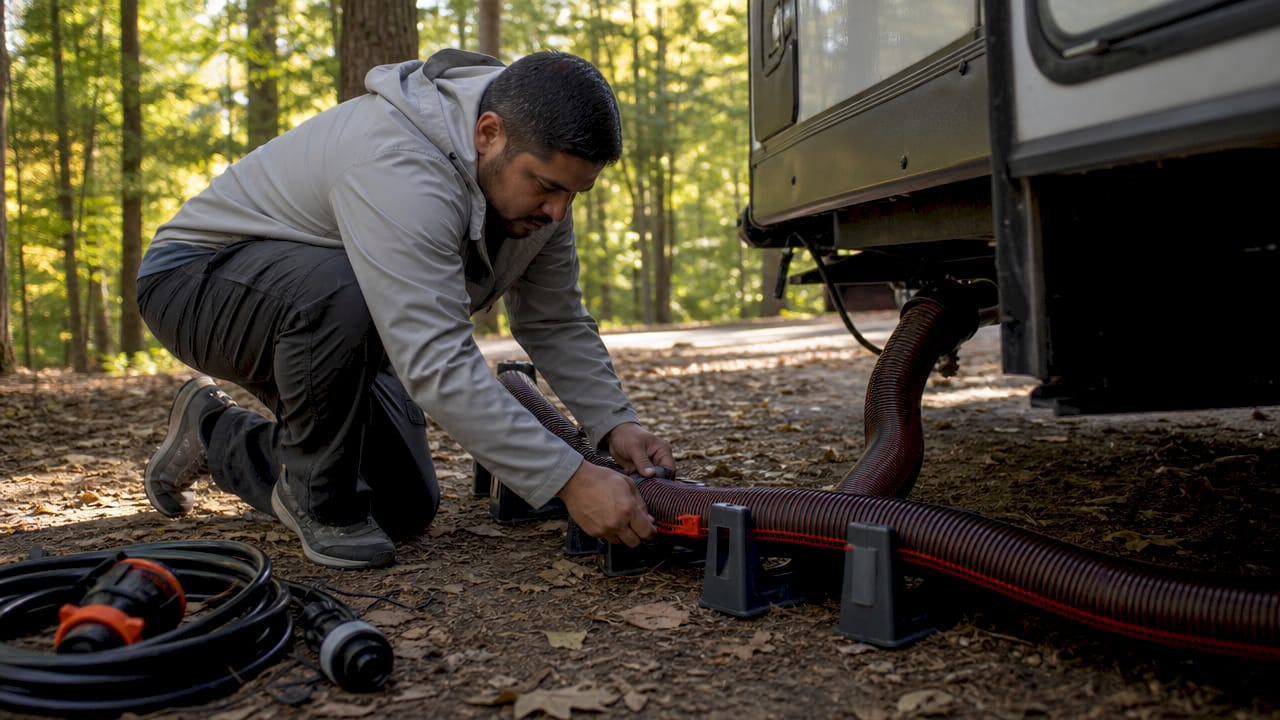
Camping sewer hose support options are devices designed to elevate and stabilize your RV sewer hose, maintaining a consistent downhill flow to the dump station. Without them, hoses sag, waste pools in low spots, and you end up with clogs, odors, and potential spills. The right support keeps your hose off the ground, protects it from rocks and debris, and makes every dump cycle faster and cleaner. Whether you camp on flat asphalt or rocky backcountry sites, the support system you choose directly affects how well your entire waste setup performs.
1. What are the main types of camping sewer hose supports?
RV sewer hose supports, the recognized industry term for these devices, fall into four main categories. Each type suits a different camping style and terrain.
- Accordion-style supports: These are the most common entry-level option. They expand and contract like a folded fan, letting you adjust the height across the full run of the hose. They are lightweight, inexpensive, and easy to set up in under two minutes. The trade-off is that they can flex under heavy hoses on very uneven ground.
- Telescoping and modular supports: These systems use interlocking sections you add or remove to match your exact hose length. They give you precise control over slope angle, which matters on sites where the ground drops away unevenly. Adjustable and foldable supports provide height customization critical for uneven terrain and ease of storage.
- Foldable stand supports: These look like a series of small legs or cradles connected by a spine. They fold flat for storage and pop open quickly at the site. They work well for RVers who prioritize compact packing.
- DIY and improvised options: Some campers use stacked bricks, wood blocks, or PVC pipe frames. These cost almost nothing but offer zero height adjustment and can shift during a dump cycle.
Most supports are made from UV-resistant plastic or powder-coated metal. UV resistance matters because sun exposure causes standard plastic to crack and become brittle within a single season of heavy use.
2. How height adjustability affects drainage performance

Height adjustability is the single most important feature in any RV sewer hose support. Premium supports allow height adjustments from 1¾ inches to 10 inches, which covers the full range of slopes you encounter at real campgrounds. That range means you can dial in a true downhill angle whether your hookup sits two inches below your RV outlet or a full foot lower.
A consistent gravity-fed slope prevents clogs and odors, especially in colder climates where pooled waste can freeze inside the hose. Simply getting the hose off the ground is not enough. Continuous downhill slope is the priority, not just elevation. A hose that rises and falls across its length creates low spots that trap waste regardless of how good the support is.
Deep cradle designs add a second layer of performance. Deep cradle supports prevent the hose from sliding off during pressurized dumping, avoiding leaks and spills. Shallow cradles let the hose shift sideways under pressure, which breaks your slope angle mid-dump.
Pro Tip: Set your supports so the hose drops steadily from the RV outlet to the dump inlet. Walk the full length and look for any section that rises or levels off. Adjust that support first before you connect the hose.
3. Which options best blend portability and durability?
Portability and durability pull in opposite directions, but the best camping waste hose solutions manage both. Foldable and nesting designs collapse into a compact footprint that fits inside a storage bay or a dedicated bag without taking up space you need for other gear.
Here is what to look for when evaluating portability alongside durability:
- UV-resistant materials: Supports that sit in direct sun all day need UV stabilizers in the plastic. Without them, the material yellows and cracks within one to two seasons.
- Chemical resistance: Sewer hoses occasionally drip. The support material should resist contact with waste chemicals without degrading.
- Carrying straps or storage bags: Some kits include a bag that keeps all sections together. This prevents losing individual cradle pieces between trips.
- Weight-to-strength ratio: Lightweight plastic supports are easy to carry but can flex under a heavy, full hose. Look for ribbed or reinforced cradle sections if you run a large-diameter hose.
- Leg staking capability: Supports that allow leg staking extend hose life by securing the system on windy or uneven ground. Stakes prevent the whole support from shifting when the hose fills with waste.
Some modern kits include a 10-foot UV-protective sleeve that covers the hose itself, adding an extra layer of protection against sun damage and abrasion. That sleeve extends hose life significantly, especially for RVers who camp in high-UV desert environments.
4. How to choose the right support length and setup
Matching your support length to your hose length is straightforward once you know the standard sizes. Most versatile supports match 15–20 foot hose lengths common at campgrounds and fit 3-inch diameter hoses, which is the industry standard for RV sewer connections.
| Hose Length | Recommended Setup | Best Terrain |
|---|---|---|
| 10 feet | Single accordion or 2-section modular | Flat or gently sloped sites |
| 15 feet | 3-section modular or foldable stand | Mixed terrain, standard campgrounds |
| 20 feet | Full accordion or 4-section modular | Uneven or extended-distance hookups |
| 30 feet | Multiple supports linked end to end | Remote sites, long runs to dump points |
For sites where the dump inlet sits far from your RV, modular systems let you add sections without buying a completely new support. This matters at older campgrounds where hookup distances vary widely from site to site.
On rough terrain, combining supports with stakes or straps enhances stability and maintains hose elevation throughout the entire dump cycle. Stakes driven into soft ground keep individual support legs from shifting. Straps looped over the hose and clipped to the support cradle prevent lateral movement on rocky surfaces.
5. Practical tips to get more from your support system
A good support system works even better with a few practical habits layered on top.
Pro Tip: On windy sites, stake every other support leg into the ground. Wind catches the hose like a sail and can pull the entire support run out of alignment mid-dump.
Additional steps that extend performance and hose life:
- Use multiple supports on long runs. A single support at the midpoint of a 20-foot hose still leaves 10 feet of unsupported hose on each side. Place supports every 4–5 feet for a consistent slope.
- Inspect cradles before each trip. Cracks in the cradle arms let the hose drop through under load. A cracked cradle is a spill waiting to happen.
- Clean supports after each use. Rinse with water and a mild detergent. Waste residue accelerates plastic degradation and creates odors in your storage bay.
- Pair supports with a protective sleeve. The sleeve shields the hose from abrasion where it contacts the cradle edge, especially on accordion-style supports with sharper plastic edges.
- Supporting the hose off the ground prevents punctures from rocks and twigs and extends hose lifespan. This is especially true on gravel sites where sharp edges are everywhere.
Regular maintenance takes less than five minutes per trip and adds years to both the hose and the support system.
Key takeaways
The most effective RV sewer hose support system combines continuous downhill slope, deep cradle stability, and terrain-matched height adjustability to prevent clogs, odors, and hose damage.
| Point | Details |
|---|---|
| Slope over elevation | A continuous downhill angle matters more than simply getting the hose off the ground. |
| Height range matters | Supports adjustable from 1¾ to 10 inches handle the full range of campground terrain. |
| Deep cradles prevent spills | Shallow cradles let hoses shift during dumping; deep cradles lock the hose in place. |
| Match length to your hose | Use modular or linked supports for 20–30 foot hoses to maintain slope across the full run. |
| Stake on rough ground | Leg stakes and straps keep supports from shifting on rocky, uneven, or windy sites. |
What I’ve learned from watching RVers set up their hose supports
The most common mistake I see at campgrounds is RVers who elevate the hose but never check the slope. They put one support under the middle of the hose and call it done. The result is a hose that peaks in the center and slopes downward in both directions. Waste pools right at that peak and never fully clears.
The second mistake is using a support that is too short for the terrain. A support maxing out at 4 inches of height cannot compensate for a site where the ground drops 8 inches over 15 feet. Modular systems solve this because you can raise individual sections independently. I always recommend a system with at least a 10-inch maximum height for this reason.
Securing supports on rough ground is non-negotiable. I have seen a full hose pull an unsecured accordion support completely sideways during a dump cycle. Stakes take 30 seconds to set and prevent that entirely. The why every RVer needs a support comes down to one thing: a support that holds its position is the only support worth using.
— Rvlevitator
Rvlevitator’s terrain-ready sewer hose supports
Rvlevitator builds sewer hose supports specifically for the uneven ground that real campgrounds throw at you. The design holds a consistent downhill slope regardless of what the terrain does underneath it, which is the core problem most generic supports fail to solve.

Rvlevitator’s supports are compatible with standard 3-inch diameter hoses and common lengths from 10 to 20 feet. The system is lightweight enough to store in a small bay compartment and sets up without tools. Rvlevitator backs every product with a money-back guarantee, so you can test it on your next trip with zero risk. Browse the full range of RV sewer hose supports and find the right fit for your rig and your most common camping terrain. You can also explore complete hose support kits that include accessories for a full setup.
FAQ
What is the standard hose diameter for RV sewer supports?
The standard RV sewer hose diameter is 3 inches. Most sewer hose supports on the market are designed to fit this size.
Are sewer hose supports required by law at campgrounds?
Some Western U.S. campgrounds legally require sewer hose supports to prevent ground contamination. Arizona is one example where this mandate applies, so check campground rules before you set up.
How many supports do I need for a 20-foot hose?
Place supports every 4–5 feet along the hose run. For a 20-foot hose, that means four to five individual support points to maintain a consistent downhill slope.
Can I use a sewer hose support on rocky or uneven ground?
Yes. Use a modular or telescoping support system that lets you adjust each section independently. Add leg stakes or straps at each support point to prevent shifting on rough terrain.
How do I clean and store my sewer hose support?
Rinse the support with water and mild detergent after each use, then let it dry before folding or collapsing it for storage. Store it in a bag or dedicated compartment to keep all sections together between trips.
Leave a Reply